Skip to content

Laser-Cut, Bent, and Rolled Metal for Landscape Architecture

Laser-Cut, Bent, and Rolled Metal for Landscape Architecture

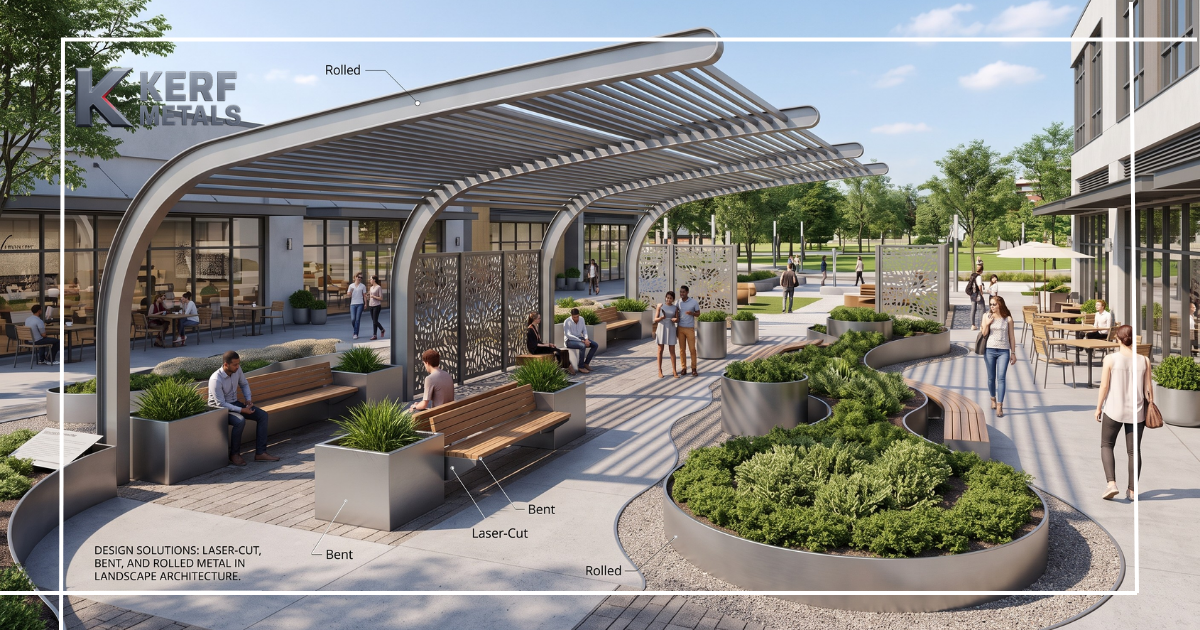
Modern landscape architecture often depends on custom metal components to turn detailed designs into functional outdoor spaces. Planters, privacy screens, edging systems, benches, pergolas, signage, railings, and decorative features may all require parts made to specific dimensions.
Kerf Metals supports these projects by providing precision laser cutting, metal bending, and metal rolling services. We do not provide landscape architecture, installation, or complete landscape construction. Instead, we manufacture metal parts from customer-supplied drawings, CAD files, dimensions, and production requirements.
These components can then be welded, assembled, finished, and installed by landscape contractors, architectural fabricators, product manufacturers, or other members of the project team.

Laser-Cut, Bent, and Rolled Metal for Landscape Architecture

Where Metal Parts Are Used in Landscape Projects

Metal offers the strength, formability, and visual flexibility required for many residential, commercial, hospitality, and public landscape projects. Depending on the design, fabricated metal parts may support both structural and decorative applications.

Common examples include:

  • Decorative and privacy screen panels

  • Rectangular and circular planter components

  • Landscape edging and border systems

  • Bench frames, bases, and supports

  • Pergola and shade-structure components

  • Signage and wayfinding panels

  • Railing and guardrail components

  • Tree grates and protective surrounds

  • Outdoor kitchen and fire-feature parts

  • Brackets, mounting plates, frames, and connectors

  • Curved entry features and architectural accents

Kerf Metals produces the individual parts required for these applications. The customer or their project team remains responsible for engineering approval, assembly, welding, finishing, installation, and compliance with applicable building requirements.

Laser Cutting for Detailed Landscape Components

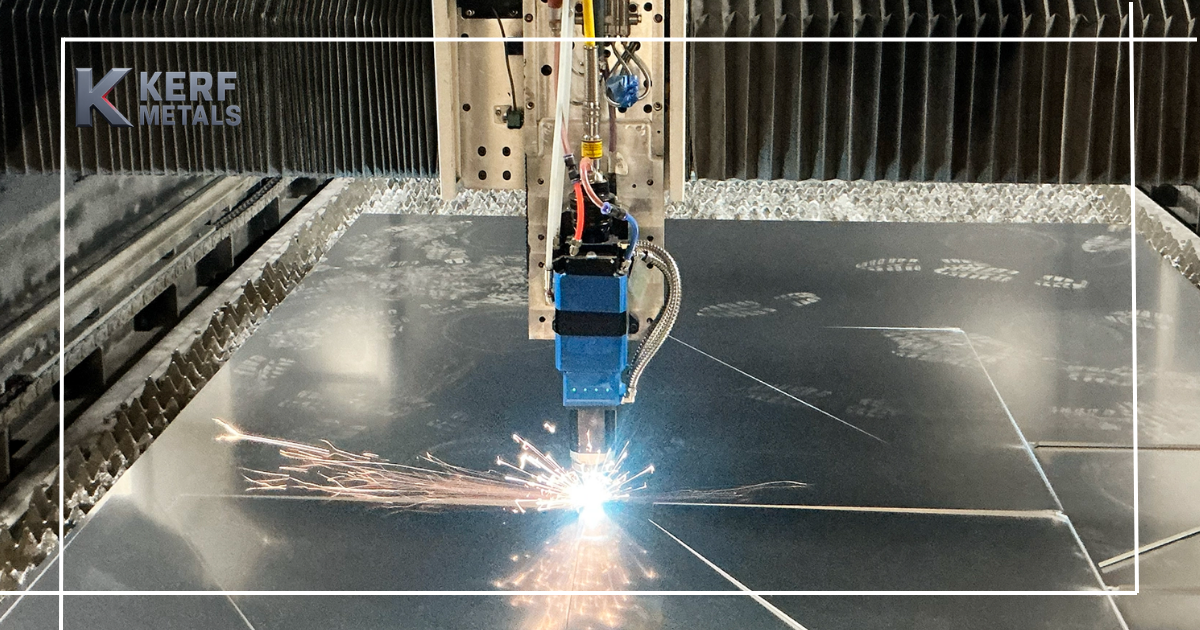
Precision laser cutting is well suited to landscape components that require clean edges, detailed geometry, accurate openings, or consistent repetition.

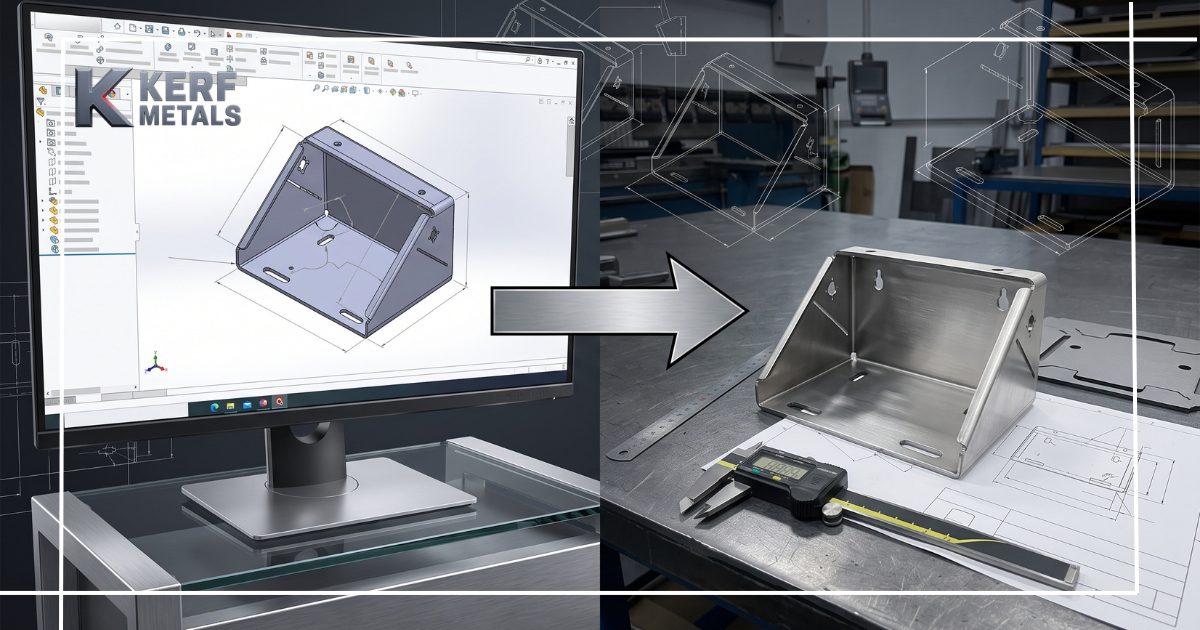
A digital design can be transferred directly from a suitable CAD file to the cutting process. This allows the same pattern or component geometry to be repeated across multiple panels while maintaining consistent dimensions.

Laser-cut parts for landscape architecture may include:

  • Decorative screen and privacy panel blanks

  • Panels with geometric or organic patterns

  • Custom signs, lettering, and address panels

  • Mounting plates and connection tabs

  • Bench and furniture components

  • Pergola brackets and base plates

  • Planter walls before bending

  • Drainage openings and access panels

  • Custom trim and edging profiles

Laser cutting can also reduce the amount of manual cutting required later in the fabrication process. Slots, holes, tabs, and connection points can be included in the original file, helping downstream fabricators assemble parts more efficiently.

Kerf Metals processes aluminum, stainless steel, and carbon steel for custom parts. Material choice should be specified by the customer based on structural needs, exterior exposure, finish, maintenance requirements, and the conditions at the installation site.

Laser Cutting for Detailed Landscape Components

Metal Bending for Planters, Edging, and Structural Parts

After flat metal is cut, many components require one or more precise bends. Metal bending services transform flat blanks into functional three-dimensional parts with specified angles and dimensions.

In landscape-related projects, bent parts may be used for:

  • Rectangular planter walls and corners

  • Landscape edging sections

  • Bench frames and supports

  • Equipment covers and enclosures

  • Stair, railing, and guard components

  • Channels, caps, trims, and flashing

  • Brackets and mounting assemblies

  • Folded screen and signage elements

Accurate bending is especially important when several parts must align during welding or assembly. An incorrect angle can create uneven joints, alignment problems, or additional rework on site.

Producing the cut and bent features through one supplier can also simplify coordination. Kerf Metals can review the supplied files and process parts through cutting and bending before they move to the customers next production stage.

Metal Rolling for Curved Landscape Designs

Landscape designs frequently use curves to follow paths, define planting areas, surround trees, or create circular gathering spaces. These parts may require metal rolling rather than a series of sharp press-brake bends.

Metal rolling gradually forms a flat sheet, plate, bar, or profile into a controlled radius. The process can support components such as:

  • Circular or curved planter walls

  • Curved landscape edging

  • Arched pergola components

  • Radius bench frames

  • Curved privacy-screen sections

  • Circular surrounds and rings

  • Curved entrance features

  • Rolled structural or decorative profiles

Rolling helps create a smoother and more continuous curve than segmented fabrication. The required radius, material, thickness, part length, and final application should be clearly identified in the project drawings.

When a component requires both cut details and a specific curve, Kerf Metals can use laser cutting and rolling as connected production steps. This helps maintain the relationship between holes, slots, edges, and the final formed geometry.

Metal Rolling for Curved Landscape Designs

Selecting Metal for Exterior Components

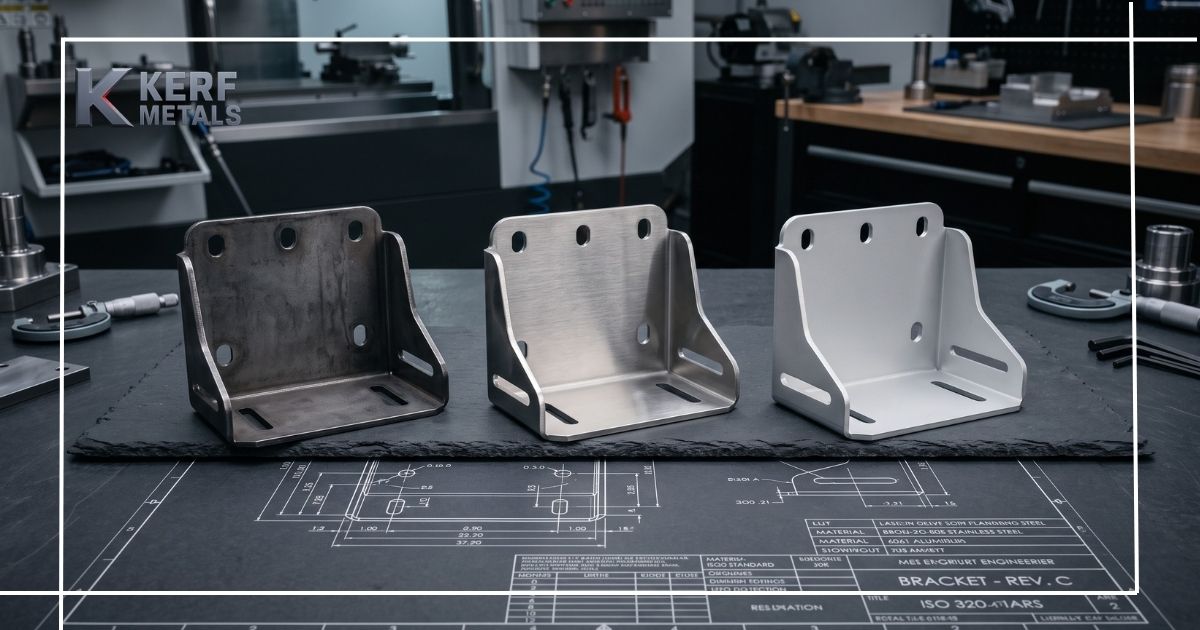
Material selection affects strength, weight, corrosion resistance, appearance, finishing options, and long-term maintenance. Common materials for outdoor metal parts include:

Aluminum

Aluminum is lightweight and naturally corrosion-resistant. It can be considered for screens, panels, trims, signs, and components where reduced weight is useful.

Stainless Steel

Stainless steel provides good corrosion resistance and a clean appearance. It may be specified for exposed components, premium architectural details, brackets, and parts used in demanding exterior environments.

Carbon Steel

Carbon steel offers strength and versatility for frames, bases, supports, brackets, planters, and heavier components. Exterior carbon-steel parts generally require an appropriate protective finish selected for the expected environment.

The landscape architect, engineer, contractor, or product manufacturer should determine the appropriate alloy, thickness, finish, and corrosion-protection system. Soil contact, irrigation, coastal exposure, drainage, freeze-thaw conditions, and dissimilar-metal contact may all affect that decision.

From Design File to Production-Ready Metal Parts

A clear production file helps prevent delays and reduces uncertainty during quoting. A typical workflow includes:

  1. The customer submits CAD files, technical drawings, material requirements, and quantities.

  2. Kerf Metals reviews the supplied information for the requested cutting, bending, or rolling operations.

  3. Flat components are laser-cut to the required geometry.

  4. Parts are bent or rolled according to the approved dimensions.

  5. Completed parts are prepared for delivery and the customer’s next production stage.

For an accurate quote, include the material, alloy when applicable, thickness, overall dimensions, quantity, bend angles, inside radii, rolled radii, tolerances, and preferred file format. DXF, STEP, PDF, and other CAD formats can be submitted through the Kerf Metals quote form.

One Metal Processing Partner for Multiple Project Components

Landscape projects can involve many unique parts in relatively small quantities, followed by repeat orders as a project expands or moves into additional phases. Working with one source for laser cutting, bending, and rolling can reduce the need to move partially processed parts between several vendors.
Kerf Metals supports prototypes and production runs for contractors, manufacturers, architectural teams, and outdoor product companies. Our role is focused: produce accurate metal components that are ready for your team to weld, assemble, finish, integrate, or install.
If your landscape project includes custom screens, planters, edging, brackets, frames, curved sections, or other made-to-drawing metal parts, send us your project details.

Request a Quote for Your Landscape Metal Parts

Upload your drawings and include the material, thickness, dimensions, quantities, bend requirements, rolled radii, and project timeline. Request a quote from Kerf Metals and receive a response within 24 hours.

Choosing the Right Metal for Fabrication

Choosing the Right Metal for Fabrication

A successful fabrication job doesn’t start on the shop floor. It starts long before a sheet ever touches the laser table, press brake, or plate roller.

It starts with picking the right material.

Get this choice wrong, and you’re setting yourself up for cracked bends, premature rust, frustrating welds, unexpected weight issues, or costs that spiral way out of budget. Get it right, and everything downstream flows better—faster torch time, easier assembly, lower overall costs, and a part that actually lasts in the field.

The trick is accepting that there’s no single “best” metal out there.

Carbon steel, stainless steel, and aluminum are all outstanding materials, but only when matched to the job they were built for. Picking between them comes down to what the finished part needs to do, where it will live, how you plan to shape it, and how it handles daily wear and tear.

Here is how to break down that decision in practice.

Choosing-the-Right-Metal-for-Fabrication

Start With the End Product, Not the Price per Sheet

When choosing metal, the absolute worst place to start is:

“What’s the cheapest sheet on the rack today?”

Instead, run through these practical questions first:

  • What kind of load or force will this part take?

  • Is it going inside a climate-controlled room or sitting out in the weather?

  • Will it run into water, road salt, harsh chemicals, or frequent washdowns?

  • Does total weight matter for shipping, installation, or performance?

  • How are we shaping it—laser cutting, brake forming, rolling, or welding?

  • Are any of these faces going to be visible in the final assembly?

  • How many years does this component need to stay in service?

  • What bend radii and tolerances does the print call for?

A sheet that looks like a bargain on a distributor’s quote can quickly become the most expensive option on the floor once you factor in extra secondary ops, tricky finishing, constant maintenance, or early field replacement.

You aren’t just buying raw metal—you’re choosing a material that needs to move smoothly through your shop and perform reliably for the customer.

Start With the Finished Part, Not the Raw Material

The 5 Core Factors Driving Metal Selection

1. Load and Structural Requirements

First, figure out what forces your part will handle.

A heavy machinery bracket, a control panel enclosure, a decorative screen, an architectural column, and a rolled tank shell all ask completely different things from a material.

  • Carbon Steel is the classic go-to for load-bearing structural parts. It offers high strength and rigidity without driving material costs through the roof.

  • Stainless Steel delivers strong structural integrity alongside built-in protection against moisture and chemical exposure.

  • Aluminum knocks off a massive amount of weight, but it won’t match steel’s raw stiffness at the exact same gauge. That doesn’t mean aluminum is weak—it just means you need to design around its physical properties by adjusting wall thickness, temper, geometry, or gusseting.

2. Operating Environment

Environment will rule out certain metals before you even generate a toolpath.

Bare carbon steel is great indoors in dry, stable air. Put it outside without paint, powder coating, or galvanizing, and it will start rusting almost immediately.

Stainless steel handles wet conditions, food production lines, chemical washdowns, and weather far better. Even so, stainless isn’t totally bulletproof. You still need to pick the right grade and surface finish—especially if salt spray, deicing agents, or high chlorides are in the picture.

Aluminum forms its own thin oxide layer that naturally resists corrosion in many outdoor setups. Anodizing or powder coating adds even more protection while giving you control over color and appearance.

If your project is going anywhere near New Jersey or New York, pay close attention to environmental exposure. A bracket mounted inside a dry commercial warehouse faces completely different conditions than a rooftop frame, a highway barrier, or a coastal architectural fixture.

3. Weight Considerations

Weight isn’t just about shipping freight. It impacts almost every stage of a part’s lifespan, including:

  • Structural load on supporting members

  • Field installation labor and safety

  • Fuel efficiency and transport limits

  • Equipment payload limits

  • Wear on moving components

  • General ease of handling during assembly

With roughly one-third the density of steel, aluminum is usually the top choice for vehicle bodies, access panels, covers, mobile equipment, or anything workers have to lift manually on a regular basis.
Steel stays the practical pick whenever raw strength, stiffness, or wear resistance takes priority over weight savings.

4. Fabrication Behavior

A metal might look brilliant on a mechanical spec sheet, but if it fights you during cutting and forming, your production line will feel it fast.

Every metal reacts differently to shop processes:

  • Heat input from laser cutting

  • Bending pressure on the press brake

  • Material springback after forming

  • Tight radius limits before cracking

  • Rolling force requirements

  • Weld puddle control and heat distortion

  • Thread tapping and machining

  • Surface preparation for coating

Material grade, temper, thickness, grain direction, and bend line orientation all interact with each other. That’s why it always pays to review material choices with your fabricator before locking down final production prints.

5. Total Life-Cycle Cost

The raw material invoice is only a piece of the final price tag.

Real project cost includes:

  • Cutting speeds and assist gas use

  • Tooling setup and potential wear

  • Forming complexity and scrap rates

  • Secondary deburring or surface prep

  • Welding labor and prep work

  • Freight and job site handling

  • Protective coatings or plating

  • Long-term maintenance and replacement downtime

Saving a few dollars on a cheaper sheet that requires frequent repainting or breaks down early usually ends up costing far more over the life of the installation.

Metal Breakdown: Pros, Cons, and Best Uses

Carbon Steel: The Reliable Workhorse

Low-carbon and mild steels are the backbone of modern industrial manufacturing. They’re affordable, widely available, easy to work with, and weld clean.

Best Used When:

  • High structural strength and stiffness are required

  • The component supports heavy static loads

  • Overall weight isn’t a dealbreaker

  • The design involves welded frames or structural assemblies

  • You need to keep raw material costs under control

  • You plan to apply paint, powder coat, or plating

  • The part operates in dry, indoor conditions

Typical Uses: Machine frames, equipment bases, heavy brackets, mounting plates, safety guards, structural channels, custom machinery parts, and construction weldments.

The Main Trade-Off:

Unprotected carbon steel rusts—period. If your part sits outdoors, gets washed down, or copes with high humidity, you must factor in protective finishing like powder coating, wet paint, zinc plating, or hot-dip galvanizing.

Carbon Steel_ The Cost-Effective Structural Workhorse

Stainless Steel: Strength, Hygiene, and Corrosion Defense

Stainless steel shines when parts run into water, chemicals, frequent cleaning, or severe outdoor exposure. The chromium blended into the steel forms a self-healing passive surface layer that keeps rust at bay.

Best Used When:

  • Excellent corrosion resistance is non-negotiable

  • Equipment requires daily washdowns or sanitary cleaning

  • Parts must meet food-grade or medical standards

  • An exposed, attractive metallic finish is desired

  • The operating environment is humid or chemically aggressive

  • You want to minimize ongoing maintenance in the field

  • Grade 304: The versatile standard for general industrial equipment, architectural accents, enclosures, brackets, and indoor food equipment.

  • Grade 316: Upgraded with molybdenum for harsher environments – ideal for salt spray, marine exposure, chemical processing, and coastal installations.

The Main Trade-Off:

Stainless steel comes with a higher material cost and demands more attention during fabrication. It work-hardens quickly and exhibits significant springback during bending, meaning tool selection, bend allowances, and angle settings require tight control.

Stainless Steel_ Corrosion Resistance, Strength, and Cleanability

Aluminum: Lightweight, Clean, and Adaptable

If shedding weight is top priority, aluminum is usually your best starting point. Beyond its low weight, it offers good natural corrosion resistance and excellent thermal conductivity.

Best Used When:

  • Saving weight directly improves design performance

  • Parts need to be easy to lift, ship, or install

  • You need natural weather resistance without heavy coatings

  • Heat dissipation is needed (e.g., electronic enclosures)

  • You plan to anodize or powder coat for visual finish

  • The component goes into a vehicle or mobile system

Typical Uses: Sheet metal enclosures, light brackets, covers, transit components, architectural cladding, signage, and heat sinks.

The Main Trade-Off:

Alloys and tempers matter immensely with aluminum. Soft grades bend easily, but harder tempers will snap if you force them around a tight radius. Aluminum also pulls heat away quickly during welding, requiring careful heat control to avoid warping or burn-through. Soft threads can also strip out over repeated use, so threaded inserts (like Helicoils or PEM studs) are often necessary.

Aluminum_ Lightweight, Corrosion-Resistant, and Highly Versatile

What About Galvanized Steel?

Galvanized steel offers a handy middle ground between raw carbon steel and stainless. It’s carbon steel protected by a factory-applied zinc coating that acts as a sacrificial shield against rust.

Best Used For:

  • Outdoor framing and structural supports

  • HVAC ducting and utility boxes

  • Agricultural equipment enclosures

  • Construction components exposed to damp air

Key Caution:

Cutting, welding, or grinding galvanized sheet damages or burns off the zinc layer at the edge or joint. Those bare spots need post-fabrication cold-galvanizing touch-ups to retain their rust resistance.

How Material Selection Impacts Shop Operations

1. Laser Cutting

A fibre laser handles all three main metals well, but each reacts differently:

  • Carbon Steel: Cuts cleanly across a wide gauge range using oxygen or nitrogen assist gas.

  • Stainless Steel: Uses high-pressure nitrogen to blow away molten metal, leaving clean, bright, burr-free edges ready for immediate welding or assembly.

  • Aluminium: Reflective and thermally conductive, requiring carefully tuned power and speed settings to prevent dross and ensure a square cut edge.

2. Metal Bending

Press brake operations rely entirely on how a metal yields:

  • Mild Steel: Predictable yield point and manageable springback. Very forgiving across standard die widths.

  • Stainless Steel: Requires significantly higher tonnage to form and springback is pronounced. Dies must be chosen carefully to avoid marking visible surfaces.

  • Aluminium: Highly dependent on alloy and temper. Grain direction plays a huge role in preventing cracks along bend lines. Cutouts and holes must also stay clear of the bend zone to prevent distorting out of round.

3. Metal Rolling

Rolling plate or sheet into cylinders, cones, and arcs demands predictable material behaviour:

  • Mild Steel: Rolls consistently with predictable crown control, making it ideal for pressure vessels, tanks, and large structural rings.

  • Stainless Steel: Takes higher rolling pressure and springs back aggressively. Seam alignment requires careful prep for post-roll welding.

  • Aluminium: Great for light cylinders or curved architectural panels, but requires generous minimum radii to avoid stretching or surface marring.

How Material Choice Affects Shop Operations

Quick Reference Material Guide

Project Goal

Recommended Starting Material

Lowest raw material cost + structural strength

Carbon Steel

Heavy load-bearing frame or base

Carbon Steel

Outdoor structural steel (cost-conscious)

Galvanized Steel or Painted Carbon Steel

Washdown, food, or sanitary equipment

304 Stainless Steel

Coastal, marine, or high-chloride air

316 Stainless Steel

Lightweight enclosure, panel, or bracket

Aluminum

Heat dissipation or electronic housing

Aluminum

Mobile, transit, or vehicle parts

Aluminum

Curved structural shell or tank

Carbon Steel (or Stainless depending on media)

Connecting the Dots: Cut, Bend, and Roll

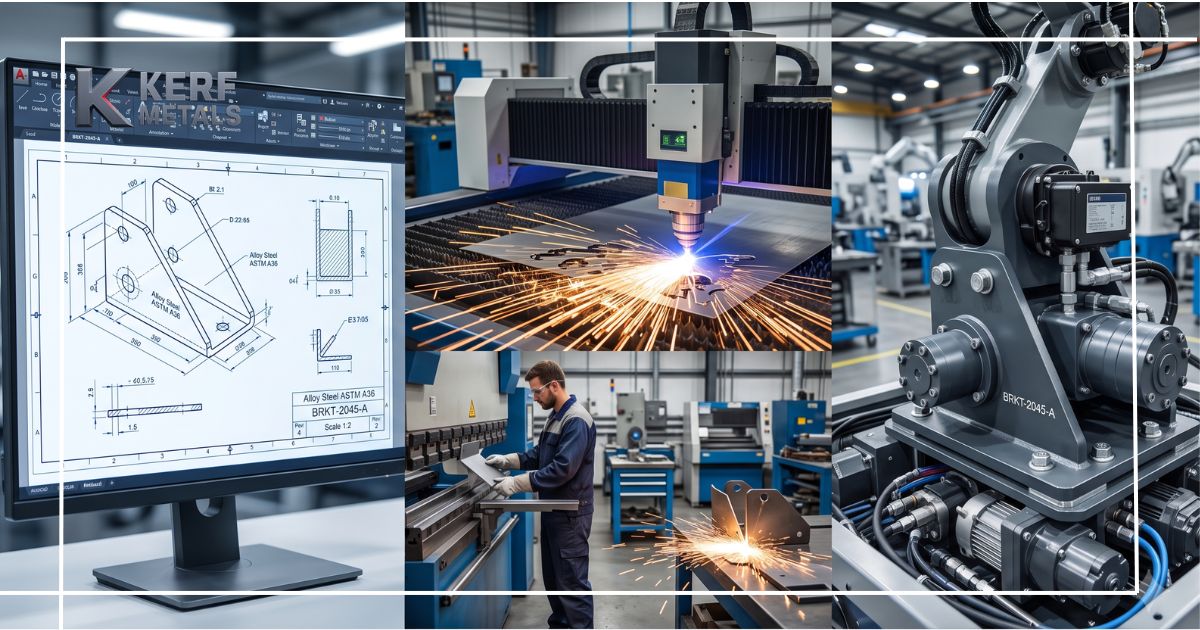
The smoothest production runs happen when laser cutting, bending, and rolling are planned as one connected workflow.

At Kerf Metals, material selection and CAD files are evaluated with every downstream operation in mind:

  • Laser cutting files incorporate correct kerf offsets and lead-ins for the chosen material.

  • Bend lines, hole locations, and springback allowances are verified before the press brake fires.

  • Rolled parts account for straight tail allowances, seam locations, and final weld prep.

By managing these three core operations under one roof, manufacturers, OEMs, contractors, and engineering teams across New Jersey and New York avoid vendor ping-pong, dimensional mix-ups, and costly job site delays.

Talk to Your Fabricator Before Finalizing Prints

You don’t need every single detail worked out before reaching out. Sending preliminary drawings early allows us to suggest minor tweaks that can save real time and money.

When requesting a quote, try to share:

  • CAD files (STEP, DXF, or PDF)

  • Where and how the part will be used

  • Preferred material and gauge (if known)

  • Estimated production quantities

  • Weight or load considerations

  • Surface finish requirements

  • Critical dimensions and tolerances

Frequently Asked Questions

What is the best metal for laser cutting?

Carbon steel, stainless steel, and aluminum all cut cleanly on modern fiber lasers. The “best” one depends entirely on your needs for strength, weight, corrosion resistance, and post-cut finishing.

Both perform well outdoors, but in different ways. Aluminum is lightweight and naturally resists rusting, making it great for covers and panels. Stainless steel offers far greater mechanical strength and impact resistance. For severe coastal salt exposure, 316 stainless steel or anodized marine-grade aluminum are your best options.

Low-carbon (mild) steel is the most predictable and forgiving. Aluminum forms easily as well, provided you choose a bendable alloy and temper (like 5052-H32). Stainless steel requires the highest tonnage and exhibits the most springback.

Yes. Partnering with a single shop for laser cutting, brake forming, and plate rolling ensures your flat blanks are prepped accurately for secondary forming, keeping tolerances tight from start to finish.

Yes. Based in Middlesex, New Jersey, Kerf Metals supplies custom laser cut, bent, and rolled metal components to OEMs, contractors, and manufacturers throughout New Jersey, New York, and surrounding regions.

Why American Precision Metal Fabrication Is a Strategic Advantage for OEMs

Why American Precision Metal Fabrication Is a Strategic Advantage for OEMs

For years, the standard playbook for OEM procurement teams was straightforward: blast out RFQs globally, pick the quote with the lowest unit price, sign the purchase order, and move on. That usually meant shipping jobs across the globe where labour rates looked low, and sea routes seemed reliable enough.
Then reality hit. Cargo ships backed up at port, container rates went through the roof, and a single delayed bracket or mispunched enclosure brought a multi-million-dollar assembly line to a grinding halt.
Suddenly, those “cheap” components didn’t look like such a deal. Today, selecting a domestic metal fabrication partner isn’t just a routine purchasing decision-it directly determines your line speed, working capital, design agility, and brand reputation.

Why American Precision Metal Fabrication Is a Strategic Advantage for OEMs

Looking Beyond the Piece Price: The Real Math of Metal Sourcing

When you review a metal quote, the piece price is only a fraction of the equation.
What happens when you add ocean freight, import duties, harbor maintenance fees, third-party CMM inspections, and emergency safety stocks? What about the hidden costs of late shipments, misaligned mounting holes, uneven powder coat finishes, or late-night emails struggling to negotiate engineering change notices (ECNs) across a 12-hour time difference?
When you add up those line items, that low unit price evaporates fast.
Forward-thinking OEM buyers and manufacturing engineers evaluate vendors based on Total Cost of Ownership (TCO). In sheet metal and heavy plate fabrication, real savings come from looking at the full operational picture-raw material fluctuations, tariffs, freight, warranty claims, and supply chain agility.
The real question isn’t “Who can laser-cut and bend this part for the fewest dollars on paper?”
It’s “Which precision fabricator helps us build reliable products with the lowest overall risk to our production schedule?”

Shorter Supply Chains Keep the Assembly Floor Moving

Precision OEM manufacturing runs on a tight rhythm. If a main chassis, structural frame, or custom bracket fails to show up on schedule, your entire assembly team sits idle.

When your fabricator is operating across an ocean, your options during a crisis are painfully limited. Air-freighting heavy steel or aluminum plate is obscenely expensive. Replacement runs take weeks to punch, form, and ship across sea lanes. Quick design adjustments drag out over days of frustrating back-and-forth messages.

Partnering with an American metal fabricator cuts down that physical distance. Bringing production back onshore delivers:

  • Predictable, realistic lead times: No waiting weeks for containers to clear customs.

  • Agile volume adjustments: The freedom to scale orders without wrecking your master schedule.

  • Minimal exposure to freight spikes: Less risk from global shipping shocks and fuel surcharges.

  • Leaner safety stocks: Free up valuable warehouse space and working capital.

  • Direct access to experts: Talk directly to the manufacturing engineers, programmers, and welders crafting your parts.

It doesn’t make risk disappear entirely, but it puts you back in control. If a revision hits or demand surges, you can call the shop floor-or visit in person-and resolve it the same day.

Shorter Supply Chains Keep the Assembly Floor Moving

Why Single-Roof Integrated Fabrication Matters

Geographic proximity is a solid start, but a fabricator’s internal shop setup matters just as much.

If a domestic vendor outsources every step-sending fiber laser cutting to one shop, press brake bending to another, CNC machining somewhere else, and powder coating across town-you still end up with long lead times, extra markup, and finger-pointing when a quality defect crops up.

The true competitive advantage comes from working with a single-roof precision metal fabricator. An integrated facility keeps core capabilities under one roof: DFM engineering, high-speed laser cutting, precision bending, CNC machining, AWS-certified welding (MIG/TIG/robotic), hardware insertion (PEM installation), powder coating, and final assembly.

Single-source fabrication removes handoffs and creates complete accountability.

Here’s what that looks like on the shop floor:

  • Instant problem solving: If a material springback issue or tight bend radius causes a fit-up problem, the welder, brake operator, and DFM engineer walk over to the part together and fix it immediately.

  • Consistent quality control: From the initial sheet cut to final CMM inspection and finish testing, every step follows one unified ISO quality standard.

  • True flexibility: Need five prototype enclosures built before locking in a production run of 5,000? An integrated shop can pivot smoothly without re-negotiating terms across four different subcontractors.

Why Single-Roof Integrated Fabrication Matters

Precision Downstream: Protecting the Complete OEM Assembly

A fabricated metal component rarely stands alone. It bolts into a complex frame, shields sensitive electronics, or mates with hydraulic lines and machined fittings.
If a mounting hole is off by half a millimeter, a weld seam distorts the mating surface, or a bend has too much springback, the problem multiplies down the line. Your assembly crews end up redrilling holes, forcing fits, or scrapping parts outright.
Precision isn’t just about making one pristine sample for approval. It’s about repeatability over hundreds or thousands of cycles. Can the fabricator deliver part #500 with the exact same tolerances, deburring, and surface finish as part #1?
A reliable American metal fab partner invests in multi-axis CNC equipment, modern fiber lasers, calibrated press brakes, and AWS-certified welders to ensure every batch drops right onto your production line without hiccups.

DFM: Engaging Metal Fabricators Early in Design

Product design is rarely a straight line. A 3D CAD model looks flawless on screen, but sheet metal behaves differently in the real world under bend pressure, heat distortion, and grain orientation.

When OEMs collaborate early with experienced fabricators through Design for Manufacturability (DFM), they unlock massive savings before a single sheet of steel or aluminum is cut.

An experienced metal fabricator can spot critical details early:

  • Complex bend sequences that require custom, expensive tooling when a standard punch and die set would work.

  • Overly tight tolerances on non-critical dimensions that drive up machining costs unnecessarily.

  • Opportunities to combine welded sub-assemblies into a single folded sheet metal part.

  • Alternative material grades (e.g., swapping hard-to-source alloys for readily available 304 stainless or 6061 aluminum) that maintain structural integrity while cutting lead times.

  • Ideal PEM hardware placement to avoid interference during press brake operations.

This early feedback loop prevents costly tooling reworks, reduces material scrap rates, and accelerates time-to-market-giving you a sharp edge over competitors stuck in slow revision cycles.

Smarter Inventory: From Safety Stocks to Blanket Orders

Ordering metal components from overseas forces you into massive minimum order quantities (MOQs) just to fill container space. That locks up cash flow and leaves you with obsolete inventory whenever an engineering change notice (ECN) drops.
Domestic fabrication lets you adopt agile inventory strategies like Kanban, Just-In-Time (JIT) delivery, or stocking agreements. You can order in smaller, more manageable batches tied directly to your actual build schedule.
If market demand surges, your fabricator can ramp up production. If you launch a Version 2.0 design, you aren’t stuck scrapping tons of outdated metal parts sitting in a warehouse.

From Safety Stocks to Blanket Orders

A Strategic Business Advantage, Not Just Sourcing

At the end of the day, sourcing domestic metal fabrication isn’t just about patriotic branding-it’s a clear business strategy.

It’s about risk mitigation, speed, cash flow management, and tight quality control. While simple, ultra-high-volume commodity stampings might still make sense offshore, complex, tight-tolerance, and mission-critical fabricated metal components belong closer to home.

The modern question for OEM procurement isn’t whether domestic metal fabrication costs a few cents more per unit on paper.

The real question is: What is it costing you in delayed shipments, scrap, field rework, and halted assembly lines to source overseas?

Partnering with an experienced, integrated American metal fabrication shop is a direct investment in a resilient, high-performing manufacturing operation.

How to Prepare CAD Files for Laser Cutting Quotes

How to Prepare CAD Files for Laser Cutting Quotes

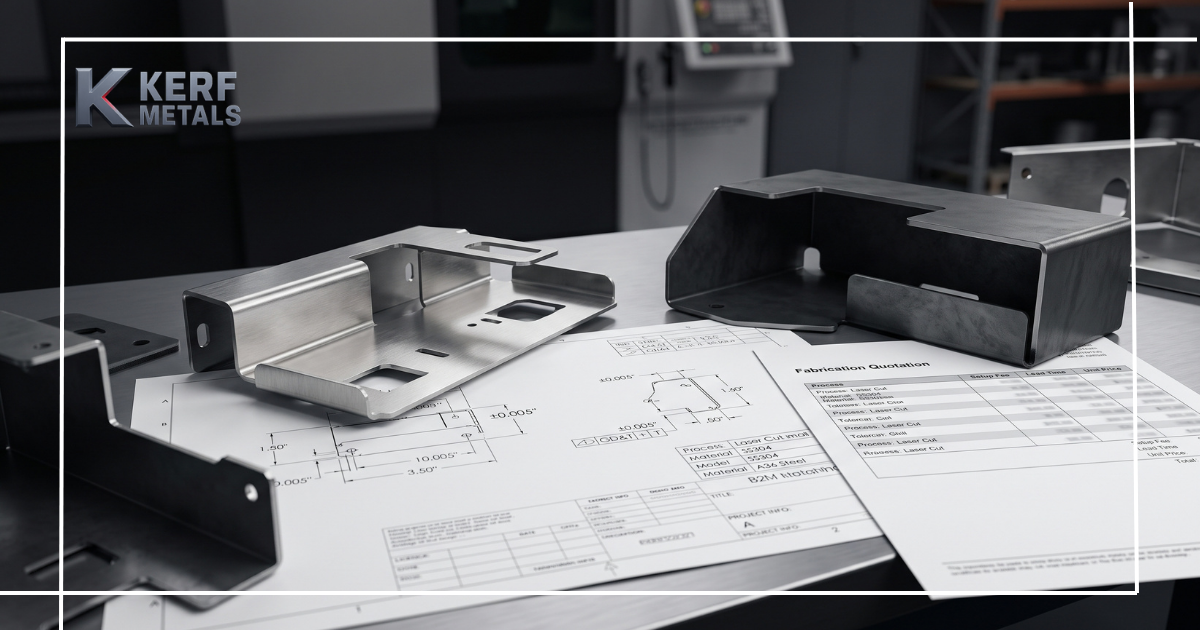
A clean CAD file can make the difference between a fast, accurate laser cutting quote and days of back-and-forth clarification.

For metal parts, your file is not just a drawing. It is the starting point for quoting, programming, nesting, cutting, and, when needed, downstream processes such as bending or rolling. If the geometry is unclear, the units are wrong, or key project details are missing, the quote may take longer — and the final part may not match your intent.

At Kerf Metals, we provide precision laser cutting, metal bending, and metal rolling services for custom metal parts. To help us review your project quickly and quote it accurately, here is how to prepare your CAD files before submitting a request.

Research on sheet metal manufacturing also supports why this matters: sheet metal blanks are often developed through CAD and then cut using CNC equipment, while nesting and sheet utilization directly affect material usage, scrap, and cost.

How to Prepare CAD Files for Laser Cutting Quotes

Why CAD File Quality Matters

Laser cutting machines follow digital geometry very literally. Small issues that may look harmless on screen can create real production problems.

Common CAD file problems include:

  • Open contours
  • Duplicate or overlapping lines
  • Wrong units or scale
  • Missing material thickness
  • Unclear tolerances
  • Extra title blocks, dimensions, or construction lines inside the cut file
  • Splines or unsupported geometry
  • No distinction between cut lines, bend lines, and etching/marking lines

Several laser cutting file-preparation guides point out the same issue: bad DXF or DWG files often create quoting delays, extra programming time, mis-cut parts, scrap, or avoidable setup costs.

The cleaner your file is, the easier it is to quote your part accurately, plan material usage, and move the job into production.

Best File Formats for Laser Cutting Quotes

For most laser cutting projects, DXF is the preferred format.

DXF is widely used because it is a practical exchange format for 2D cutting geometry. DWG is also useful, especially if the file was created in AutoCAD, but DXF is usually safer when sending a 2D profile to a laser cutting supplier. Tech industry notes that DXF is generally the better choice for CNC and laser cutting because it is widely compatible and commonly accepted by shop-floor software.

Recommended file formats

Format

Best use

DXF

Best option for 2D laser cutting profiles

DWG

Good if created in AutoCAD or similar CAD software

STEP / STP

Helpful for 3D review, especially if bending is involved

PDF

Good as a reference drawing, not ideal as the main cut file

AI / SVG

Sometimes useful for vector artwork, but must be clean and properly scaled

Use 1:1 Scale and Confirm Units

Your CAD file should be drawn at actual size, meaning 1:1 scale.

If a part is supposed to be 10 inches long, the CAD geometry should measure 10 inches. If it is supposed to be 250 mm long, it should measure 250 mm in the file. One of the most common errors in laser cutting files is a unit mismatch, especially when inches and millimeters are confused. Lumen Future and Admati both emphasize that 1:1 scale and correct units are critical for avoiding parts that cut too large or too small.

When submitting a quote to Kerf Metals, include:

  • The drawing units
  • At least one reference dimension
  • Material thickness
  • Quantity
  • Any critical dimensions or tolerances

A reference PDF is also helpful because it lets us verify that the CAD file opened at the intended size.

Keep Cut Geometry Clean and Closed

For laser cutting, every exterior profile, hole, slot, and internal cutout should be a closed loop.

Open paths can create confusion in CAM software. Even a tiny gap can cause the machine path to stop, restart, or require manual repair. Laser Cutting Experts recommends closed profiles, joined geometry, and removal of duplicates or stray lines before export.

Before sending your file, check for:

  • Open contours
  • Duplicate lines
  • Overlapping geometry
  • Tiny leftover line fragments
  • Unjoined corners
  • Stray construction lines
  • Hidden geometry
  • Unnecessary centerlines or dimensions inside the cutting file

A clean file should contain only the geometry needed to manufacture the part.

Separate Cut Lines, Bend Lines, and Marking Lines

If your part only needs laser cutting, the file can usually be simple: one clean layer for the cut profile.

If your part also needs metal bending, make the bend information clear. Do not leave bend lines mixed into the cut profile without explanation. Use a separate layer or provide a PDF drawing showing:

  • Bend location
  • Bend direction
  • Bend angle
  • Inside radius, if required
  • Finished dimensions after bending
  • Critical flange dimensions

If your part requires metal rolling, include the required radius or diameter, arc direction, material thickness, and final shape requirements. For rolled parts, a flat DXF may not be enough by itself; a reference drawing or 3D model can help clarify the intended result.

For any etching, engraving, or part marking, use a separate clearly named layer and explain whether the line should be cut, etched, marked, or used only as a reference. Lumen Future recommends separating cut, score, and engrave features by layers or colors to avoid ambiguity.

Color-coded DXF file showing separate layers for laser cutting, press brake bending, and etching

Do Not Over-Specify Tolerances

Laser cutting is precise, but every process has limits. Material type, thickness, heat behavior, geometry, and part size can all affect the final result.

A common quoting issue is when every dimension is marked with a very tight tolerance, even when only one or two dimensions are functionally critical. Overly tight tolerances can increase review time and cost because they may require special handling, inspection, or process adjustments.

One of the laser cutting tolerance guidelines also notes that tolerances are material-dependent and should be treated as general guidance rather than a one-size-fits-all rule.

For the best quote, specify:

  • General tolerance expectations
  • Critical dimensions only where needed
  • Hole sizes that must fit hardware
  • Mating surfaces
  • Bend-related dimensions
  • Any dimensions that affect assembly

This helps Kerf Metals understand what matters most and quote the job appropriately.

Account for Kerf — But Do Not Guess

Kerf is the width of material removed by the cutting process. It matters because the laser does not cut with zero width.

In many cases, the cutting team will apply the proper kerf compensation during programming. That is why it is usually best to send the nominal finished part geometry, not a manually offset version, unless you have already discussed this with the supplier.

A previous Kerf topic document also identified kerf compensation, nesting, waste reduction, and accurate steel cutting as important educational topics for potential customers.

When submitting files, tell us if:

  • Your DXF is already kerf-compensated
  • The geometry represents finished part size
  • Internal holes or slots have critical fit requirements
  • Parts are designed to interlock or tab together

This prevents double compensation or incorrect sizing.

Technical diagram explaining laser cutting kerf width and beam offset compensation

Include Material, Thickness, and Quantity

A CAD file alone is not enough for an accurate quote.

To quote laser cutting properly, Kerf Metals needs to know the material and production requirements. Material type and thickness affect cutting parameters, edge quality, time, and cost.

Include:

  • Material type: mild steel, stainless steel, aluminum, etc.
  • Material grade, if known
  • Thickness or gauge
  • Quantity per part
  • Whether this is a prototype or repeat production
  • Required turnaround, if urgent
  • Any finish requirements
  • Any bending or rolling requirements

One file-preparation guide also highlights that material, quantity, tolerances, and finishing details should be sent with the file for faster and more accurate quoting.

Should You Nest the Parts Yourself?

In most cases, no.

Unless you have a very specific layout requirement, it is usually better to send the individual part files and let the cutting team handle nesting. Professional nesting considers sheet size, part spacing, grain direction, kerf, material usage, and machine constraints.

The uploaded manufacturing research also explains that nesting is used to pack blanks onto raw sheets to improve material utilization and reduce scrap, but larger or more complex nesting groups can also increase handling complexity.

For quote requests, Kerf Metals can better evaluate the job when the files are clean, clearly named, and accompanied by material and quantity details.

Optimized CAD nesting layout packing multiple custom sheet metal parts onto a single raw sheet

CAD File Checklist Before Requesting a Quote

Before sending your file to Kerf Metals, review this quick checklist:

  • File is DXF or DWG
  • Geometry is 2D and drawn at 1:1 scale
  • Units are clearly stated
  • Profiles are closed loops
  • Duplicate and overlapping lines are removed
  • Construction lines are deleted or separated
  • Cut, bend, and marking lines are clearly identified
  • Material type and thickness are included
  • Quantity is included
  • Critical tolerances are marked
  • A reference PDF is included
  • Bending or rolling requirements are clearly shown
  • File names are clear and organized

A clean submission helps us quote faster and reduces the chance of production delays.

What to Send Kerf Metals for the Fastest Quote

For the best result, send:

  1. DXF or DWG filefor laser cutting
  2. PDF drawingwith dimensions and notes
  3. Material type and thickness
  4. Quantity needed
  5. Tolerance requirements
  6. Bending details, if required
  7. Rolling details, if required
  8. Project notes, including finish, fit-up, or assembly requirements

The more complete the information, the more accurate the quote.

The Sheet Metal Nesting Sweet Spot

Final Thoughts

Preparing CAD files correctly is one of the easiest ways to reduce quoting delays, avoid rework, and get better laser cut parts.

A good file gives the cutting team clean geometry. A complete request gives them the context they need: material, thickness, quantity, tolerances, and any bending or rolling requirements.

At Kerf Metals, we help customers turn CAD files into precise metal parts through laser cutting, metal bending, and metal rolling. Whether you need a one-off prototype or a repeat production run, a clean CAD file helps us quote your project faster and manufacture it more accurately.

Ready to start your next project?
Request a Quote and send us your CAD files for review.

Why Professional Steel Cutting Saves Money Despite Kerf Loss

Why Professional Steel Cutting Saves Money Despite Kerf Loss

Every steel cutting project comes with one unavoidable reality: some material disappears during the cut. That narrow strip of missing metal has a name — kerf — and for a lot of buyers, it sounds like straight-up waste.

Technically, it is. But here’s what actually matters: kerf loss isn’t what drives up the cost of a project. Poorly managed kerf is.

When steel gets cut without proper planning, programming, and downstream process knowledge, those tiny losses compound fast. Parts come out undersized. Holes drift off-center. Bend lines miss. Rolled components won’t fit the intended radius. A job that looked affordable on paper can quietly become expensive through scrap, rework, delays, and extra handling — and by the time you realize it, the steel’s already been cut.

That’s the core reason why working with a professional steel cutting shop saves you money, even knowing that kerf loss is part of the deal.

At Kerf Metals in Middlesex, New Jersey, we focus on the work that directly affects part accuracy and production efficiency: laser cutting, metal bending, and metal rolling. Our goal isn’t just to cut steel. It’s to make sure the parts you receive are cleaner, more predictable, and ready to move straight into the next stage of your production.

What Is Kerf in Steel Cutting?

Kerf is the width of material removed when a cutting tool passes through steel.

In laser cutting specifically, a concentrated beam melts or vaporizes a narrow line of metal. That line has a measurable width. If it’s not accounted for in the cutting program, the finished part won’t match the intended dimensions — even if everything else on the job went perfectly.

Consider this: a bracket designed to be exactly 10 inches wide can end up slightly short if the cutting path isn’t properly compensated. The same problem can ripple through slots, holes, tabs, panels, and any component that needs to mate with another part during assembly.

Kerf itself is small. But in professional manufacturing, a small dimensional error at the cutting stage can turn into a large, expensive problem by the time it reaches assembly.

Why Kerf Loss Isn’t the Real Cost Problem

The actual cost problem isn’t the thin line of steel removed by the laser. It’s what happens when that line gets ignored or guessed at.

A poorly planned cutting job can create:

  • Parts that don’t fit during assembly
  • Extra grinding or edge cleanup before parts can be used
  • Wasted sheet area that could have yielded additional parts
  • Delays between cutting, bending, and rolling stages
  • Added labor hours correcting avoidable mistakes
  • More shipping between separate vendors who don’t coordinate
  • Missed deadlines for contractors, manufacturers, and project managers

Professional steel cutting changes the economics of a job at the source. A serious shop looks beyond the cutting path — it considers the material, thickness, part geometry, bend requirements, rolling tolerances, and how each piece will be used when it gets to your facility. That planning upfront is what keeps costs from ballooning later.

Why Professional Steel Cutting Saves Money Despite Kerf Loss

Laser Cutting Reduces Waste Through Precision

Laser cutting is one of the most material-efficient methods available when accuracy, repeatability, and edge quality matter.

Because a laser produces a narrow kerf, more of each sheet becomes usable parts. That’s real money when you’re working with steel, stainless steel, or aluminum — materials where per-pound costs add up quickly on any volume order.

Professional laser cutting also reduces the secondary work that comes after the cut. Clean edges mean less time spent grinding, correcting, or preparing parts before they move to the next operation. For manufacturers and contractors, that directly translates to lower labor costs and faster turnaround.

This matters particularly for businesses throughout New Jersey who need parts that arrive production-ready — not parts that require an hour of cleanup before they can be used.

Better Nesting Means Better Material Yield

One of the most significant cost advantages of working with a professional cutting partner is nesting – and it’s one buyers rarely think to ask about.

Nesting is the process of arranging parts on a sheet in the most efficient layout possible. Good nesting minimizes the unused space between parts and squeezes more value out of every sheet you’re paying for.

Here’s the difference in practice: a low-cost cutting provider may simply run the file as you sent it. A professional cutting partner thinks about how the parts sit together on the sheet, whether grain direction will affect how something bends, where cutouts belong relative to other features, and how to reduce scrap before the first cut is ever made.

Even a modest improvement in sheet utilization creates meaningful savings across repeated orders. Saving material on one sheet is helpful. Saving material across 50 or 200 sheets is a serious competitive advantage on a production run.

Cutting, Bending, and Rolling Shouldn’t Be Treated as Separate Jobs

Most steel parts aren’t finished the moment they leave the cutting table. They still need to be bent, formed, or rolled – and that’s where a lot of hidden costs show up.

A part can be cut perfectly as a flat shape and still fail the moment it hits the brake press. If bend allowance is wrong in the flat pattern, the final formed component won’t hit the required dimensions. Holes too close to a bend line may distort during forming. Sharp internal corners can create stress concentrations. Rolled components often require different planning than flat panels or brackets – planning that has to happen before the cut, not after.

This is exactly why Kerf Metals keeps laser cutting, metal bending, and metal rolling under one roof and one conversation.

When these services are planned together, the project gets more predictable at every step. The flat pattern gets reviewed with the bend sequence in mind. The cutting strategy supports what’s coming next on the floor. Rolling requirements get factored in before the part is ever programmed. That kind of integrated planning reduces the chance of discovering a design problem after the steel is already cut – which is almost always the most expensive time to find one.

The Cheapest Quote Is Rarely the Lowest Total Cost

It’s tempting to choose the lowest cutting quote. Anyone managing a budget would consider it.

But the cheapest quote only reflects one number in a longer chain. If parts arrive with rough edges, wrong dimensions, poor hole alignment, or geometry that won’t form correctly, the real cost shows up elsewhere. In extra labor. In delays. In replacement material. In lost production time while your crew waits for parts that should have been right the first time.

In steel processing, the quote is just the entry point. The real question is: what does the part actually cost by the time it’s ready to use?

Professional steel cutting controls that final number by reducing avoidable errors from the very beginning of the job.

Local Steel Cutting in New Jersey Reduces Logistical Friction

For businesses across New Jersey and the surrounding region, working with a nearby metal processing partner creates advantages that go beyond the parts themselves.

Every time a part moves between separate vendors, you add time, communication risk, shipping cost, and accountability gaps. One shop cuts it. Another bends it. A third rolls it. When something goes wrong, tracking down where the problem started becomes its own project.

Kerf Metals simplifies that chain by handling laser cutting, metal bending, and metal rolling from one facility in Middlesex, NJ. You’re not just saving transit time. You’re giving your project a clearer production path — one team, one point of contact, one place to go when you need to talk through a design question or get a job turned around quickly.

Professional Steel Cutting Supports Smarter Design Decisions

Good steel cutting isn’t just about machine capability. It’s about understanding how design choices affect what a job actually costs in production.

Working with a professional team gives you the ability to catch issues before they become material losses. Common design-stage problems that add cost include:

  • Features placed too close to bend lines
  • Cutouts that may distort during forming operations
  • Tolerances tighter than necessary, adding cost without adding function
  • Part layouts that waste sheet material without a clear reason
  • Shapes that could be nested more efficiently with minor modifications
  • Geometry that will create challenges in rolling or bending that aren’t obvious on a flat drawing


These details can seem minor at the design stage. By the time a job is running, though, they’re often the difference between a project that flows cleanly and one that keeps stopping for corrections.

When design intent and production experience work together from the start, steel cutting becomes more than a service. It becomes a tool for controlling total project cost.

Kerf Loss Is Normal. Uncontrolled Waste Isn’t.

Every cutting method removes some material. That’s not a problem to solve — it’s a reality to manage.

With professional laser cutting, accurate programming, smart nesting, and planning that accounts for bending and rolling from the start, kerf becomes a controlled variable instead of a source of unexpected cost. The difference between simply cutting steel and producing parts that make financial sense often comes down to that level of planning.

Work With Kerf Metals for Steel Cutting in New Jersey

If your project needs accurate steel parts, clean edges, repeatable dimensions, and reliable support through forming, Kerf Metals is ready to help.

We provide:

From one-off prototypes to ongoing production runs, our focus stays the same: help businesses reduce waste, avoid rework, and keep their projects moving.

Kerf loss is part of cutting. Wasted money doesn’t have to be.

Contact Kerf Metals in Middlesex, New Jersey to request a quote for laser cutting, metal bending, or metal rolling.

How Much Material Do I Lose When Cutting Steel?

Anybody Can Cut Metal. Getting It Right Is Where the Real Value Lies.

Let’s be honest, cutting metal isn’t exactly hard. Grab a basic tool, make some sparks, and you’ve got two pieces of metal instead of one.

But getting a clean, highly repeatable, dead-accurate cut that’s actually ready for the next stage of your project? That is where things get tricky.

Depending on what you’re building, there are a dozen different ways to slice through steel, aluminium, or stainless. Hand tools, band saws, shears, plasma cutters, heavy torches, waterjets, and lasers all have their place. They all remove material, but they definitely don’t deliver the same edge quality, dimensional tolerances, or material yield.

And if you’re running a business, those differences directly impact your bottom line. A rough, jagged edge might fly for a quick patch job in the back of the shop. When your parts must fit perfectly, how you cut metal matters.

They may need to line up with pre-drilled holes.
They may need to bend the same way every time.
They may need to roll smoothly without constant adjustments.
So, cutting metal is a strategic choice, not just a shop task.

How Much Material Do I Lose When Cutting Steel?

Why "Kerf" Is More Than Just a Detail

When people think of metal waste, they usually picture the pile of scrap swept off the floor at the end of the day. But waste is often much more subtle-and expensive. It shows up in sloppy nesting layouts, wide kerf cuts, and parts that need hours of extra grinding.

Worse, it can lead to rejected parts in the scrap bin because they don’t fit.

Your material yield is simple. It shows how much usable part you get from a sheet, plate, or tube. It also shows how much material you throw away. Getting the most out of your material requires a bit of upfront planning.

That means using smart, tight nesting to get the most from each sheet.
It also means choosing a process with a narrower kerf to save material.
Keep tolerances tight so nobody wastes time trimming parts during assembly.

This is where a professional cut pays for itself. A cheap, rushed cut often ends up costing the most. Your team may spend hours cleaning up edges. They may also need to remake ruined pieces.

How Much Material Do I Lose When Cutting Steel

Choosing the Right Tool for the Job

Different projects require different tools, and every cutting method is a trade-off.

If you just need a quick, straight chop on a piece of tubing or structural steel, a band saw is great. Shearing is incredibly fast for basic sheet metal prep. Plasma is a reliable workhorse for cutting heavy steel plate when speed matters more than a clean edge. Flame cutting is the go-to choice for very thick materials. Waterjets work well on thick plates because they do not cause heat distortion.

They can be slow and costly to run.

Laser cutting is the sweet spot when you need high precision, clean edges, and minimal waste.

For sheet and plate work, it gives you the best balance of speed and dead-on accuracy. It is very useful for detailed parts, complex hole patterns, or edges that can go straight to assembly without extra cleanup. It isn’t a silver bullet for every job.

It’s about matching the method to the material and thickness.
It also depends on your project’s target budget.

How Much Material Do I Lose When Cutting Steel

A Great Cut Makes Bending and Rolling Easy

Don’t forget that cutting is rarely the final step in the process.

If your parts are headed to a press brake next, the quality of that initial cut dictates how easy they are to form. If your edges are inconsistent or your dimensions are slightly off, the bending process becomes incredibly unpredictable.

The same goes for rolling. A perfectly prepared, clean blank gives you a much better starting point for a smooth, uniform roll.

A bad early cut can affect every step of fabrication.

So, Kerf Metals focuses on core services: precision laser cutting, bending, and rolling. We don’t make finished retail products. We fabricate exact, reliable components that keep your production lines running smoothly.

How Much Material Do I Lose When Cutting Steel

Cutting Out the Rework

Rework is easily one of the biggest profit-killers in any fabrication shop. It eats up expensive labour, blows past deadlines, and turns a profitable project into a stressful loss.

Clean, highly accurate cutting is your best insurance policy against that risk. When parts are cut to match your CAD file and nested to use the full sheet, they arrive ready. You can weld, paint, or bolt them together without tedious manual adjustments. That’s the real value of working with a specialist.

Partner With Kerf Metals

Kerf Metals provides precision laser cutting, metal bending, and metal rolling services for businesses that need reliable metal processing.

We work with stainless steel, aluminium, and carbon steel projects where accuracy and clean execution matter. Whether you need custom prototypes, high-volume runs, or simple cut-to-size metal blanks, our goal is simple. We make sure your parts are right the first time. So you can move forward with confidence.

Send over your drawings, files, or project details, and we’ll help you figure out the best way to get them made.

What Is Kerf in Laser Cutting?

What Exactly is Kerf? Why This Tiny Laser Cutting Detail Can Make or Break Your Metal Parts

In our world, millimetres are miles. When manufacturing metal parts, the smallest details always determine whether a project succeeds or fails. One of the most critical—yet often overlooked—factors is “kerf.”

Simply put, kerf is the tiny sliver of metal that is vaporised or lost when the laser does its work.

Think of it like using a hand saw on a piece of wood. You don’t just get a clean split; you also get sawdust, and the board gets slightly shorter due to the blade’s width. Laser beams work the same way. When a laser cuts through steel, stainless steel, or aluminium, it doesn’t create a magical, zero-width line. It burns away a tiny sliver of metal as it moves. That missing sliver is your kerf.

If you are just cutting basic shapes where “close enough” is fine, you might not need to worry about it. But if you are manufacturing high-tolerance brackets, panels, machine parts, or enclosures, kerf is everything. Ignore it, and your finished parts will turn out too small, your bolt holes will be too sloppy, and mating components won’t line up.

At Kerf Metals, precision isn’t just a marketing word—it is built into our setup. We design our laser cutting services to give you clean edges and dead-on dimensions right from the very first cut

What Is Kerf in Laser Cutting? Precision Metal Cutting by Kerf Metals

Why Kerf Matters So Much on the Shop Floor

Laser cutting is famous for being fast, incredibly clean, and highly accurate. Because a laser beam is so narrow, the kerf is much smaller than what you’d get from a plasma cutter or a mechanical saw. But “small” doesn’t mean “zero.”

Let’s look at the math of a real-world cut.

If you draw a part with a specific outer dimension, the laser path must be slightly pushed outward. If it isn’t, the laser will eat into your actual part, leaving it undersized. The opposite is true for internal features like slots, holes, and cutouts. If you want a $10\text{ mm}$ bolt hole, the laser needs to cut slightly inside that line, or the hole will come out too large.

This is where real-world experience comes into play. Correcting the laser path, called the kerf offset, ensures the part matches the exact size in your CAD drawing.

What Actually Determines Kerf Width?

Kerf is never a fixed, one-size-fits-all number. It is constantly changing based on the specifics of the job. A few major factors include:

  • Material type and thickness: Thicker plates require more heat, which generally widens the cut.
  • Laser power and beam focus: How tight and intense is the focal point?
  • Assist gases: Whether we are using oxygen or nitrogen affects how the metal melts and clears out.
  • Cutting speed and machine calibration: How fast the head travels alters the dwell time of the heat.

Different metals behave in wildly different ways under a laser. Carbon steel doesn’t melt the same way as aluminium, stainless steel, or brass does. Intricate parts with delicate tabs or narrow bridges require extra care, because heat builds up rapidly in confined areas, which can easily widen the kerf.

We don’t guess these numbers. Getting a perfect cut requires tailoring the machine settings to the exact material and geometry of your part.

How Kerf Compensation Saves Your Project from Rework

To prevent parts from coming out wrong, we use “kerf compensation.” This simply means our programming software adjusts the cutting path to offset the width of the laser beam. Instead of cutting directly on your design line, the laser offsets itself to the waste side of the metal.

This is absolutely vital for parts that have to fit together. If you make mounting plates, tabs, slots, or interlocking brackets, even a small error can prevent assembly. A $0.1\text{ mm}$ mismatch between features may be enough to stop parts from fitting together. That means wasted material, missed deadlines, and major headaches.

At Kerf Metals, we focus on helping you bypass these headaches. We don’t build finished, fully assembled consumer products. Instead, we serve as your trusted manufacturing partner. We supply precision-cut, bent, and rolled metal parts that fit together perfectly the first time.

Better Cuts, Fewer Headaches

High-quality laser cutting isn’t just about slicing through a sheet of metal. It’s about total control over the process. When you dial in the kerf perfectly, everything else falls into place:

  • Your parts are highly accurate.
  • Edges are cleaner, with virtually no dross.
  • Interlocking pieces actually fit together without grinding.
  • There is no wasted material or costly rework.
  • Repeat production runs look identical to the first batch.

For anyone in manufacturing, construction, heavy equipment, signage, or architectural metalwork, these small details are what keep projects on schedule and costs under control.

Partner with Kerf Metals for Your Next Project

Kerf Metals provides professional laser cutting, metal bending, and rolling for businesses that need high-quality processing. We work directly with customers who already have drawings, specs, or production files ready. They just need a reliable shop to execute the work accurately.

We don’t try to do everything. We specialise in the core metal processing steps that keep your production line moving.

Whether you need flat-cut sheets, formed brackets, or rolled sections, our team delivers the accuracy your blueprints require.

Ready to get started? Send over your drawings or project specs today, and we’ll get back to you quickly with a straightforward quote.