
Laser Cutting vs. Waterjet Cutting: Which Is Better for Stainless Steel and Aluminum Projects?
When you’re staring at a stack of flat metal sheets or plates, one of the very first decisions you have to make is how to cut it. It sounds simple enough. But if you’re a manufacturer, contractor, OEM, or project manager, you know that this first step sets the tone for everything that follows.
Usually, the decision comes down to two heavy hitters: laser cutting and waterjet cutting.
Both methods can turn out highly accurate parts. Both are staples in serious industrial fabrication. But they are radically different animals. Pick the wrong one, and you’re looking at bloated costs, missed deadlines, rough edges, or parts that need hours of secondary clean-up just to be usable.
At Kerf Metals, we live and breathe precision metal processing-specifically laser cutting, sheet metal bending, and plate rolling. We want to help you cut through the noise. Here’s a no-nonsense breakdown of when to run a job on a laser, when to opt for a waterjet, and how to make the right call for your next stainless steel or aluminium project.
Laser Cutting vs. Waterjet Cutting: The Main Difference
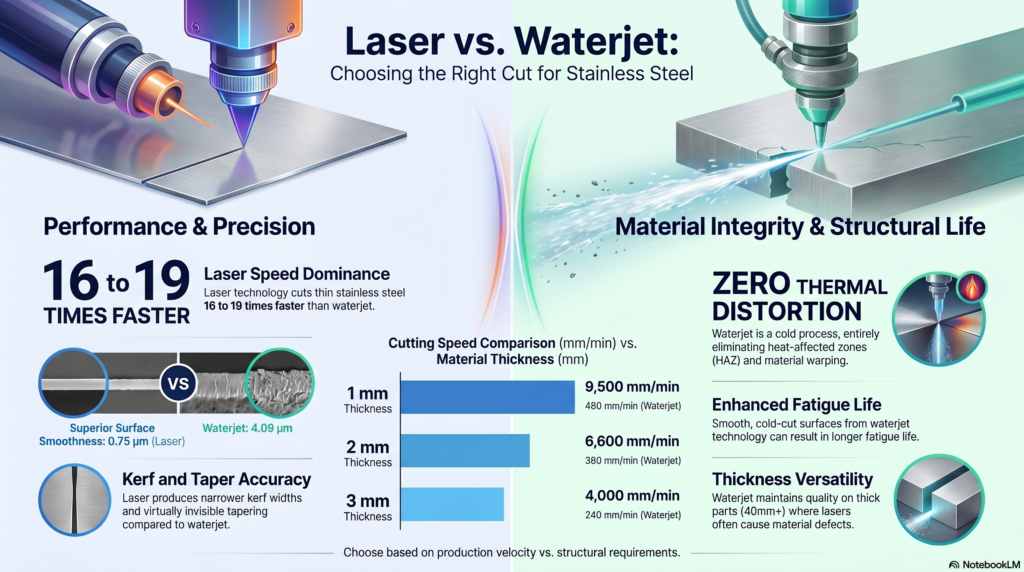
If you want to boil it down to a single concept, it’s this: lasers use intense heat, and waterjets don’t.
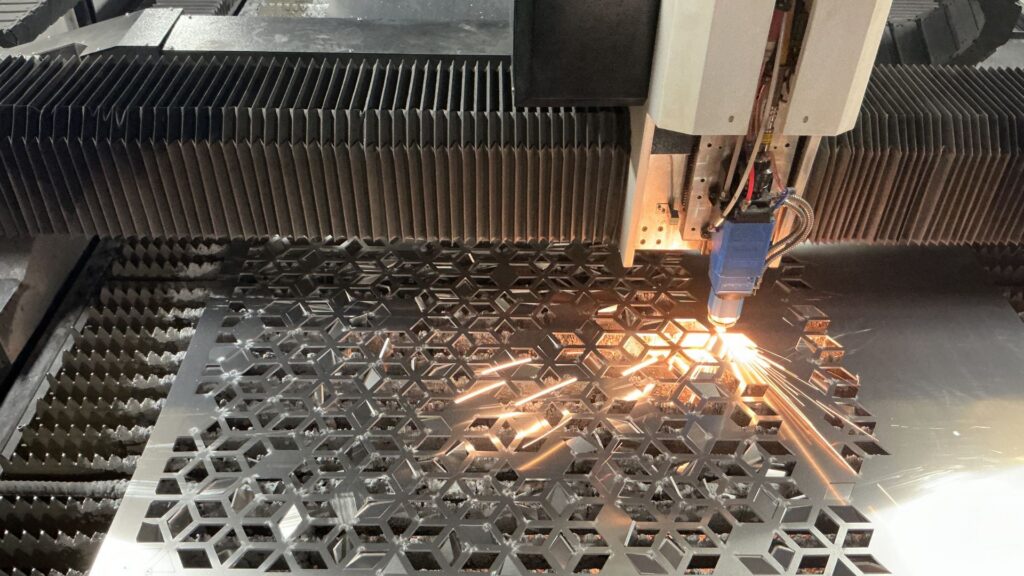
- Laser cutting uses a tightly focused beam of light paired with an assist gas to melt, burn, or blow away the metal along a programmed path. It is incredibly fast, extremely precise, and highly efficient for standard sheet metal.
Waterjet cutting is a cold process. It uses a super-high-pressure stream of water mixed with sharp, abrasive garnet particles to literally erode its way through the metal.
That single difference-heat vs. no heat-creates almost every trade-off you’ll encounter.
Lasers are the undisputed champions when you need speed, repeat accuracy, clean geometry, and low per-part costs. Waterjets, on the other hand, are the go-to when you are dealing with massive thicknesses, exotic materials, or jobs where the metal absolutely cannot tolerate heat.
When Laser Cutting Wins (And Why It Usually Does)
For the vast majority of everyday sheet metal jobs, laser cutting is the most practical, cost-effective route. It’s the natural choice for:
Stainless steel and carbon steel sheets
Aluminum brackets, panels, and covers
Parts with complex slots, fine tabs, or dense hole patterns
Prototyping and high-volume production runs
Quick-turn jobs where you need parts yesterday
The real magic of laser cutting is sheer productivity. A modern fiber laser flies through metal. It keeps dimensions incredibly consistent from the first part to the thousandth.
And let’s be honest: when you’re quoting a job, the machine’s running cost is only half the story. You also have to think about setup time, material yield, and how much labor you’ll waste grinding off burrs afterward. For fabricators and contractors across New Jersey, laser cutting strikes the sweet spot-giving you clean, ready-to-use parts on a fast timeline without breaking the bank.
Let’s Talk Money: Why Lasers Are Easier on the Budget
Waterjets are incredibly capable machines, but they are slow. Because they rely on mechanical erosion, cutting speeds are a fraction of what a laser can do on standard gauges. Plus, they eat up costly abrasive media and require constant, high-pressure maintenance.
That makes waterjet cutting expensive to run.
On standard sheet metal, lasers are so much faster that the cost-per-part drops significantly. This is especially true when you aren’t just making one bracket, but 50, 500, or 5,000.
By opting for laser cutting where it fits, you can keep a lid on:
Overall machine run time
Setup overhead
Scrap rates and material waste
Lead times
Secondary hand-finishing
If you have a massive, complex run of parts that eventually need to be bent, welded, and powder-coated, saving a few dollars per cut piece adds up fast. It can easily be the difference between winning a contract and pricing yourself out of the market.
What’s the Deal with the Heat-Affected Zone (HAZ)?
The absolute best argument for waterjet cutting is that it completely avoids the heat-affected zone (HAZ).
Because lasers melt metal, the area right along the cut edge gets incredibly hot for a split second. This rapid heating and cooling can slightly alter the metal’s properties right at the edge.
For 95% of commercial, architectural, and industrial jobs, HAZ is a non-issue. Laser-cut brackets, panels, enclosures, and architectural elements are used every single day without a single hitch.
But sometimes, it does matter. You might want to consider waterjet cutting if:
The material is exceptionally heat-sensitive.
The plate is extremely thick (where a laser would require massive heat input).
Strict engineering codes or aerospace specs ban thermal cutting.
You need to tap or machine the edges of the cut part, and you can’t risk the laser hardening the metal.
The question isn’t which machine is “better.” The question is: Does this specific part actually require a cold cut, or does it just need to be accurate, fast, and affordable? For most real-world sheet metal projects, the laser wins hands down.
The strongest argument for waterjet cutting is that it avoids the heat-affected zone, often called HAZ.
Because laser cutting uses heat, the area near the cut edge can experience thermal change. In many common commercial and industrial applications, this is not a problem. Laser-cut parts are widely used for brackets, panels, equipment parts, architectural components, stainless steel parts, and aluminum profiles.
However, HAZ can matter in certain situations.
Waterjet cutting may be better when:
- The material is extremely heat-sensitive
- The part is very thick
- The project specification does not allow thermal cutting
- The material’s edge properties must remain unchanged
- The application is highly specialized, such as some aerospace, marine, or high-performance alloy work
The key question is not “Which process is better?” The better question is:
Does this part require cold cutting, or does it need fast, accurate, repeatable metal processing?
For many real-world projects, laser cutting offers the better balance of speed, precision, and cost.
Edge Quality, Burrs, and Finishing
Edge quality is a major factor in how your project comes together.
Laser cutting produces a very narrow kerf (the width of the cut). This means you get tight, crisp corners, tiny slots, and holes that actually match your CAD file perfectly. The edges are clean and consistent.
Waterjet cutting leaves a completely different finish. Because it uses abrasive grit, the edge has a matte, almost sandblasted texture. While it’s very clean, waterjet cutting on thicker plates can suffer from “taper” (where the jet flares out at the bottom of the cut) or visible striations if the machine speed is pushed too fast.
Whatever process you choose, you have to think about what happens after the cut.
Is this edge going to be visible to the end customer?
Are you welding it right away?
Are you painting or powder coating?
Does it need to slip perfectly into another slot?
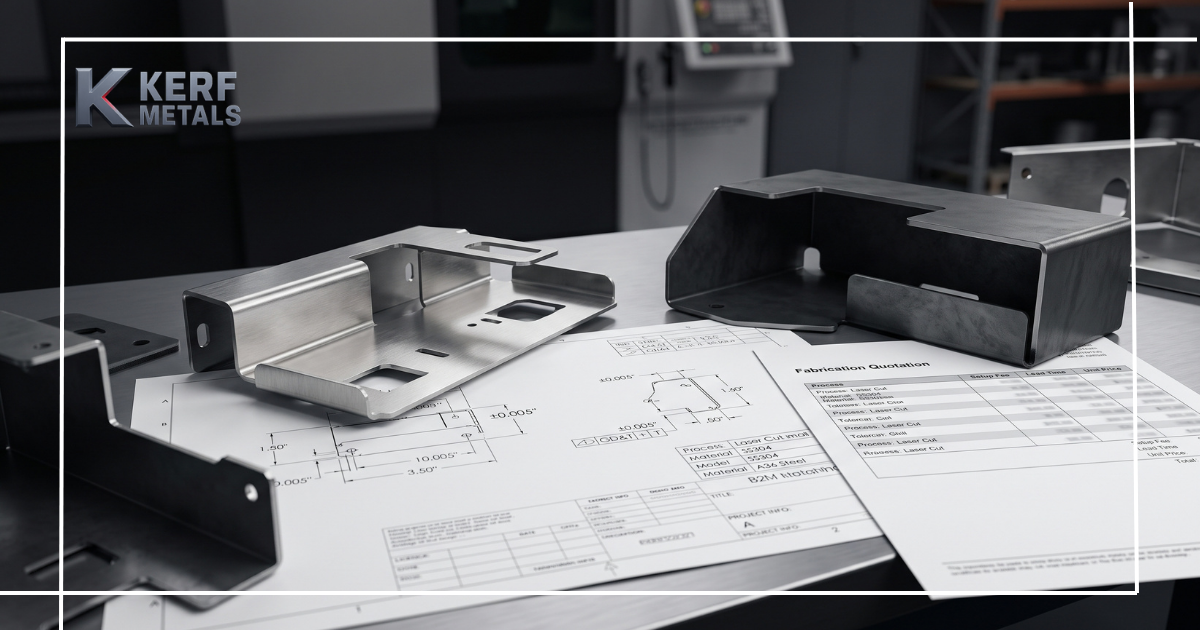
At Kerf Metals, we don’t just cut flat metal and wave goodbye. We also handle metal bending and rolling. Because we look at the whole picture, we make sure the cut quality matches the forming steps down the line. When cutting and bending are planned together, the parts fit up beautifully on your shop floor.
Stainless Steel vs Aluminium: The Breakdown
Stainless Steel
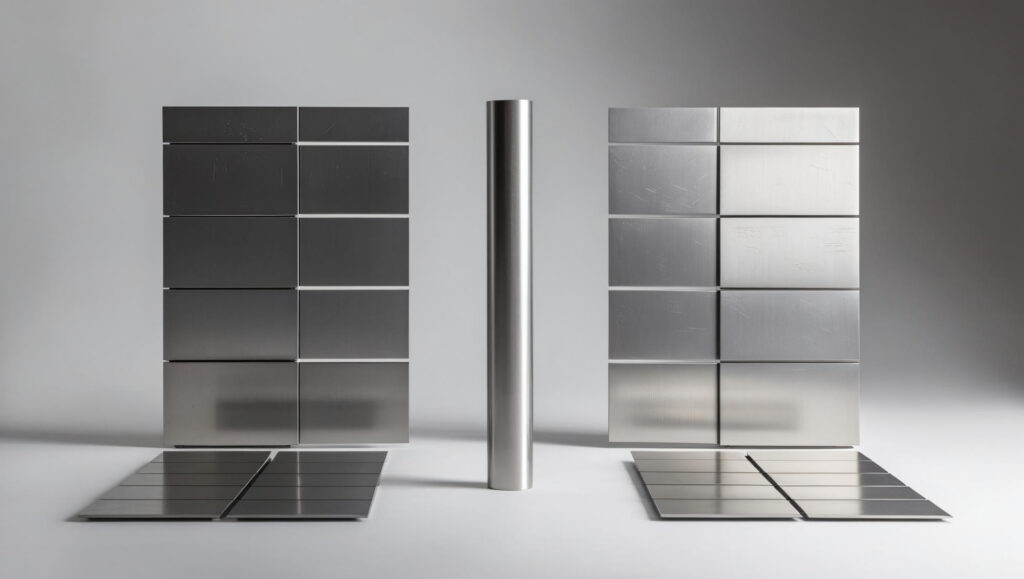
Lasers absolutely love stainless steel. It cuts cleanly, rapidly, and leaves a gorgeous edge that is perfect for kitchen equipment, architectural panels, brackets, and guards. Unless you are dealing with thick plate (typically over 1 inch) or high-spec aerospace requirements, laser is the logical choice.
Aluminum
Aluminum used to be tricky for older lasers because it’s so reflective. But modern fiber lasers handle it beautifully. For panels, custom brackets, enclosures, and light structural parts, laser cutting is incredibly efficient. Waterjet is usually reserved for very thick structural aluminum plates where heat distortion is a major concern.
Stop Treating Cutting Like an Island
The biggest mistake we see people make is treating cutting as an isolated chore.
A flat metal part is rarely the end of the road. Usually, that part has to go through a gauntlet of secondary steps:
Getting bent to a precise angle
Getting rolled into a smooth cylinder or curve
Getting welded, painted, or powder-coated
Fitting perfectly into an assembly on-site
If you don’t plan for those steps during the cutting phase, you’re going to run into trouble. A hole that looks fine on a flat layout might end up too close to a bend line, distorting into an oval when it hits the press brake.
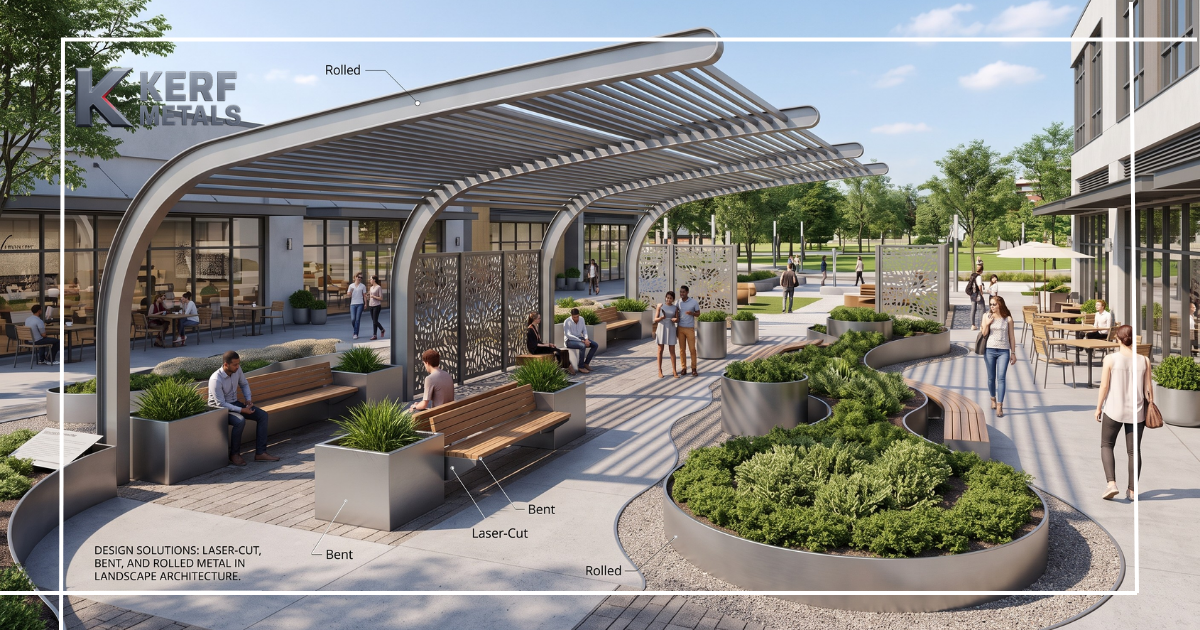
We keep our customers out of those traps by offering a cohesive, three-step metal processing workflow:
Precision Laser Cutting: For crisp flat parts, detailed designs, and highly repeatable nested sheets.
Precision Bending: For perfectly formed brackets, channels, covers, and structural profiles.
Plate & Section Rolling: For smooth, accurate curves, radiuses, and cylinders without flat spots.
By keeping these operations under one roof, we make sure your flat parts are cut with the next steps in mind.
The Verdict: How to Choose
Keep it simple:
Choose Laser Cutting if you need high speed, high accuracy, repeatable parts, standard metal thicknesses, and the best possible price per part.
Choose Waterjet Cutting if you are cutting extremely thick plates, working with highly exotic or heat-sensitive metals, or have strict engineering specifications that rule out thermal processes.
For most stainless, aluminum, and carbon steel sheet metal jobs, laser cutting is the practical, profitable winner.
Let’s Get Your NJ Metal Project Moving
You don’t need to guess which process is right or hope for the best. We’re here to help you map out the smartest, most efficient path from raw metal to a finished, usable part.
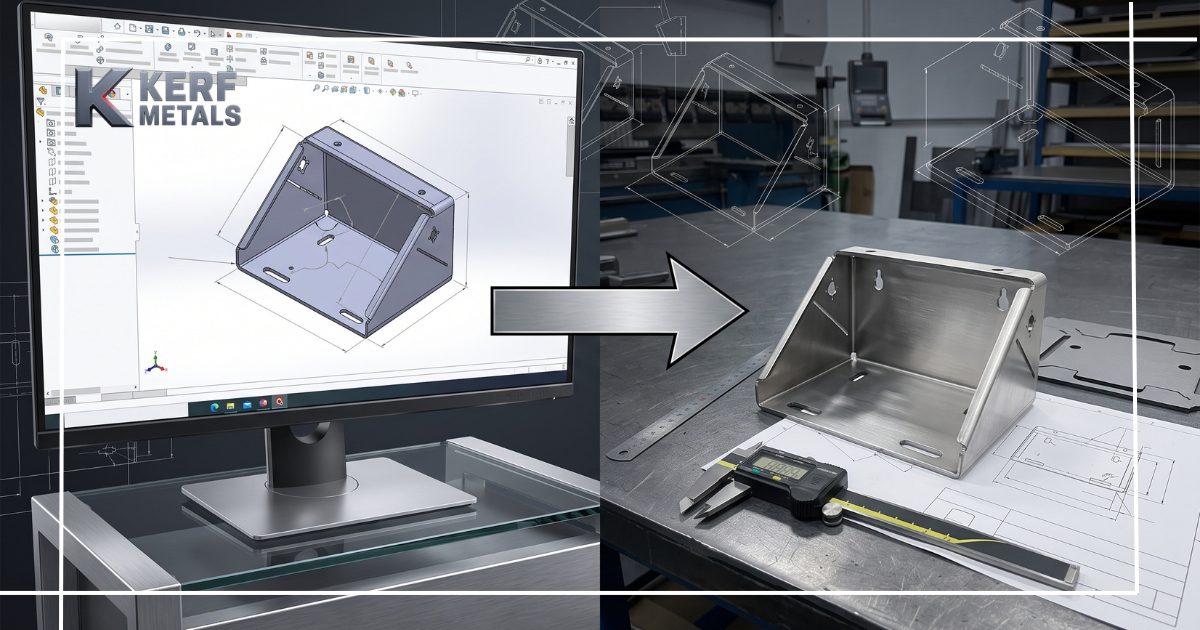
Just send us your DXF or CAD files, dimensions, material type, and quantities. We’ll look at the design, consider any bending or rolling you need, and give you a clear, honest quote.
Need clean, flat profiles? Ask us about laser cutting.
Need flanges, channels, or formed angles? Let’s talk about bending.
Need smooth curves or custom radiuses? Let’s look at rolling.
Get in touch with the team at Kerf Metals today, and let’s build something great.